DriveChains Protocol: A Dual-Token Governance and Utility System for Freight-Native Blockchain Infrastructure
Version 1.0
November 17, 2025
Polygon Network (Amoy Testnet → Mainnet)
Abstract
DriveChains is a freight-native blockchain ecosystem that implements a sophisticated dual-token architecture to separate governance from utility functions, creating a sustainable and balanced economic model for decentralized logistics infrastructure. The protocol consists of 21 smart contracts deployed on Polygon, featuring an AI-driven monetary system that dynamically adjusts token supply based on real-world freight activity, advanced governance mechanisms with timelock protection, and comprehensive staking and vesting systems.
Key Innovations:
The DriveChains protocol introduces several groundbreaking innovations that distinguish it from existing blockchain reward systems. The dual-token architecture separates governance functions (DCT) from utility functions (DCTX), creating a balanced economic model that prevents conflicts between voting power and transactional needs. The freight-native monetary system implements demand-responsive token issuance, automatically adjusting supply based on real-world freight activity metrics rather than speculation. The AI-driven injection formula calculates token minting amounts using verified driver activity, claims, and network growth indicators. Advanced governance mechanisms incorporate multi-tier voting systems with timelock protection, ensuring community review before critical changes. The comprehensive security architecture protects 15 of 21 contracts through timelock mechanisms, with multi-signature wallets securing critical operations.
1. Introduction
1.1 Background and Motivation
The global logistics and transportation industry represents over $800 billion in annual economic activity, yet the essential workers who power this system—commercial drivers—often lack access to modern financial tools and fair compensation mechanisms. Traditional reward systems are centralized, opaque, and fail to align incentives between drivers, fleet operators, and the broader ecosystem.
Blockchain technology offers a transformative opportunity to create transparent, decentralized systems that reward real economic activity. However, existing blockchain reward systems suffer from fundamental limitations: static supply models with pre-allocated pools that eventually deplete, speculation-driven economics where token value is disconnected from utility, governance conflicts in single-token systems, and lack of real-world integration.
DriveChains addresses these limitations through a freight-native design that connects token economics directly to verified logistics activity.
1.2 Problem Statement
The core problems addressed by DriveChains are:
- Unsustainable Reward Systems: Traditional reward pools deplete over time with no mechanism to replenish rewards based on activity.
- Governance-Utility Conflicts: Single-token systems force governance and utility into one asset, creating instability.
- Disconnected Economics: Token supply not responsive to real-world demand, with speculation driving value rather than utility.
- Security and Trust: Centralized control creates single points of failure with lack of transparency in reward distribution.
1.3 Solution Overview
DriveChains implements a comprehensive solution through:
- Dual-Token Architecture: DCT (Governance) and DCTX (Utility) tokens with distinct roles
- AI-Driven Monetary System: Dynamic token injection based on freight activity metrics
- Advanced Governance: Community-controlled protocol with timelock protection
- Freight-Native Design: Token economics directly tied to verified logistics activity
- Security-First Architecture: 15 contracts protected by timelock, multi-sig wallets for critical operations
2. Definitions
2.1 Key Terms
DriveChains Protocol: The complete blockchain system consisting of 21 smart contracts, governance mechanisms, and economic models for freight-native rewards.
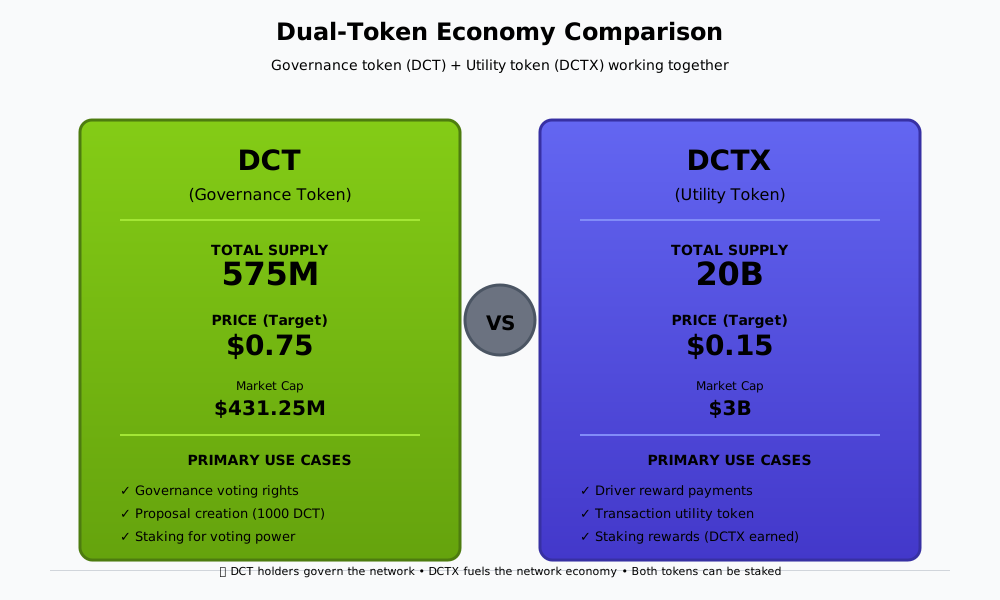
DCT (DriveChains Token): The governance token with fixed supply of 575,000,000 tokens. Used for voting, staking, and protocol control.
DCTX (DriveChainsX Token): The utility token with fixed supply of 20,000,000,000 tokens. Used for driver rewards, transactions, and ecosystem participation.
Rewards Monetary System: The AI-driven system that automatically mints DCTX tokens based on freight activity metrics.
Metric Aggregator: Smart contract that tracks and aggregates driver activity, claims, and miles for monetary system calculations.
2.2 Token Specifications
DCT Token (Governance): Symbol DCT, Total Supply 575,000,000 DCT (Fixed), Decimals 18, Standard ERC-20, Launch Price $0.75 USD, Network Polygon, Primary Use: Governance voting, staking, protocol decisions.
DCTX Token (Utility): Symbol DCTX, Total Supply 20,000,000,000 DCTX (Fixed), Decimals 18, Standard ERC-20, Launch Price $0.15 USD, Network Polygon, Primary Use: Driver rewards, network transactions, staking rewards.
3. Formalization and Previous Work
3.1 Related Work in Blockchain Logistics
Previous attempts at blockchain-based logistics systems have focused primarily on supply chain tracking and transparency. Systems like VeChain and Waltonchain provide traceability but lack economic incentives for participants. DriveChains extends this by creating a comprehensive reward system that directly compensates drivers for verified activity.
3.2 Economic Models
DriveChains implements a demand-responsive monetary system inspired by modern central banking principles but adapted for decentralized, freight-native economics. The system responds to demand, prevents hyperinflation through built-in caps, maintains stability via demand factor adjustments, and is fully governance-controlled.
3.3 Dual-Token Systems
Dual-token architectures have been successfully implemented in systems like Binance (BNB utility and governance tokens) and MakerDAO (MKR governance and DAI utility stablecoin). DriveChains extends this model by creating freight-native utility with DCTX rewards tied to verified miles driven, governance premium pricing for DCT (5x higher), and independent economics for each token.
4. DriveChains Protocol Components
4.1 Dual-Token Architecture
The DriveChains protocol uses two distinct tokens with complementary but separate functions. DCT (Governance) has a fixed supply of 575,000,000 tokens with higher value ($0.75 launch price, 5x premium over DCTX), designed for long-term holding and staking with governance features. DCTX (Utility) has a fixed supply of 20,000,000,000 tokens with lower value ($0.15 launch price), designed for frequent transactions and rewards with utility features.
4.2 Smart Contract System
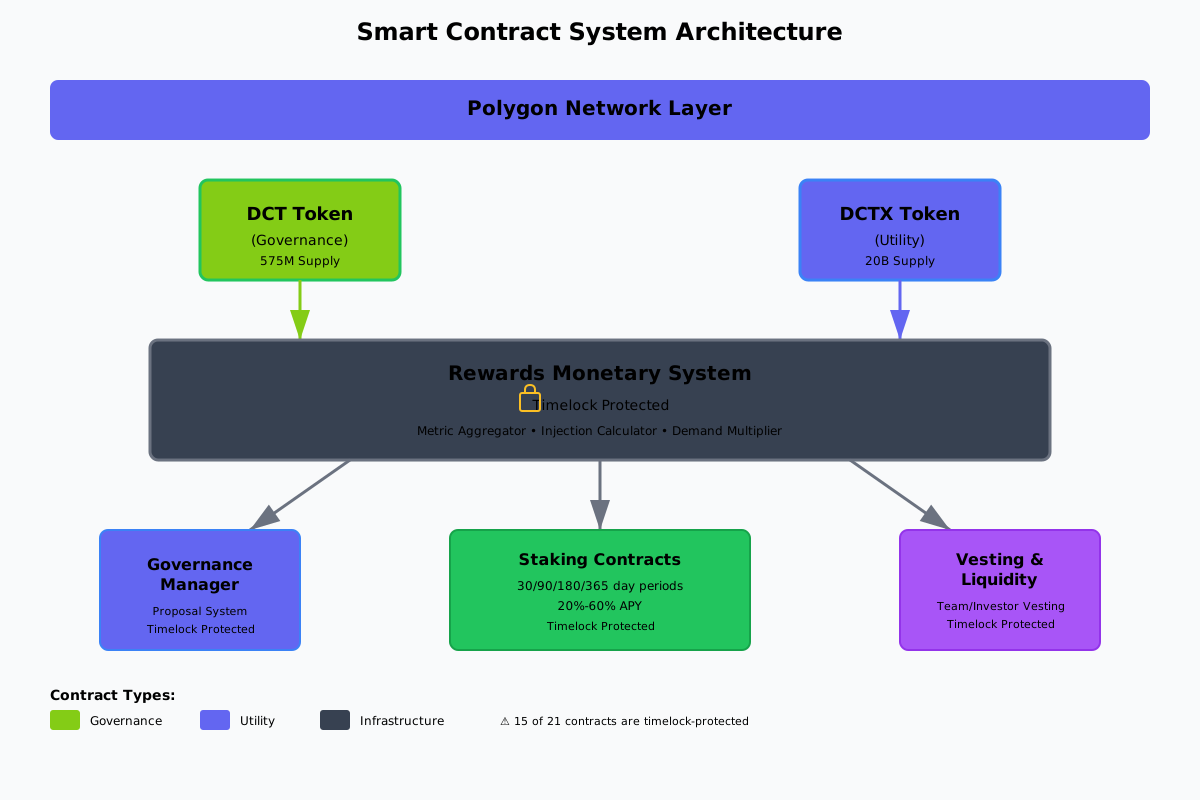
The DriveChains protocol consists of 21 smart contracts organized into functional categories: Core Token Contracts (DCTToken, DCTXToken), Rewards System Contracts (MetricAggregator, RewardsMonetarySystem, DriverRewards, RewardVault), Staking Contracts (DCTStaking, DCTXStaking, StakingMediator), Governance Contracts (GovernanceManager, ParameterGovernance, CustomTimelock), Vesting Contracts (VestingContract, VestingManager), Liquidity Contracts (LiquidityPool, DCTXLiquidityPool), and Utility Contracts (PriceOracle, TokenRegistry).
Security Status: 15 of 21 contracts are protected by CustomTimelock, with ownership transferred from deployer to timelock for enhanced security.
4.3 Rewards Monetary System
The Rewards Monetary System is the core innovation that enables sustainable, endless rewards by automatically minting DCTX tokens based on freight activity. The system architecture flows from Real Freight Activity → Metric Aggregator (tracks claims, drivers, miles) → Injection Calculator (applies formula) → Demand Multiplier (adjusts based on pool utilization) → DCTX Minting (into rewards pool) → Driver Rewards Distribution.
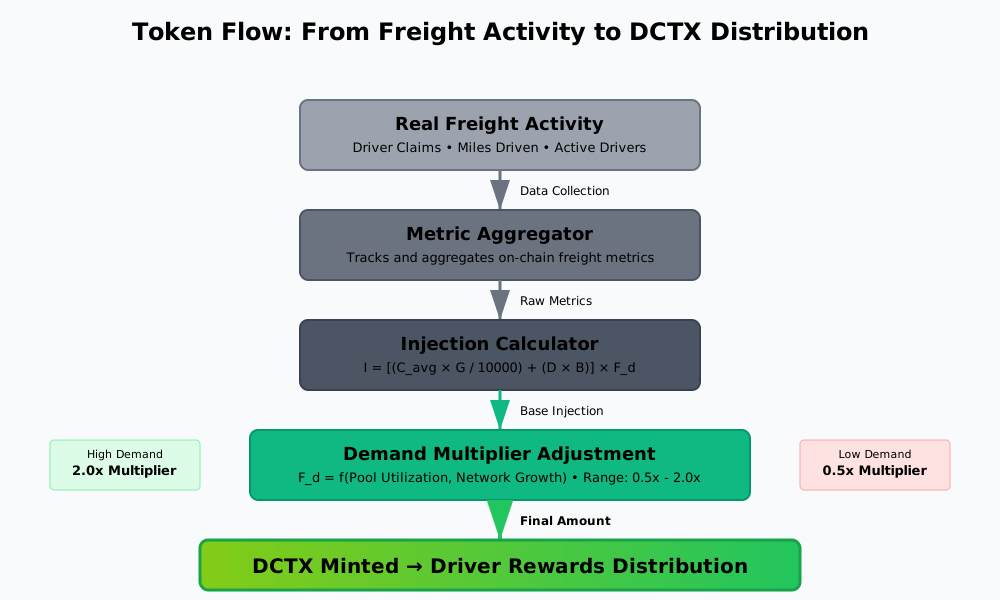
All parameters are governance-controlled: Growth Rate 200 basis points (2%), Base Mint 10 DCTX per active driver, Daily Mint Cap 1,000,000 DCTX, Annual Mint Cap 100,000,000 DCTX, Injection Interval 24 hours, Demand Factor Range 0.5x to 2.0x, Target Pool Size 4,000,000,000 DCTX.
4.4 Governance Framework
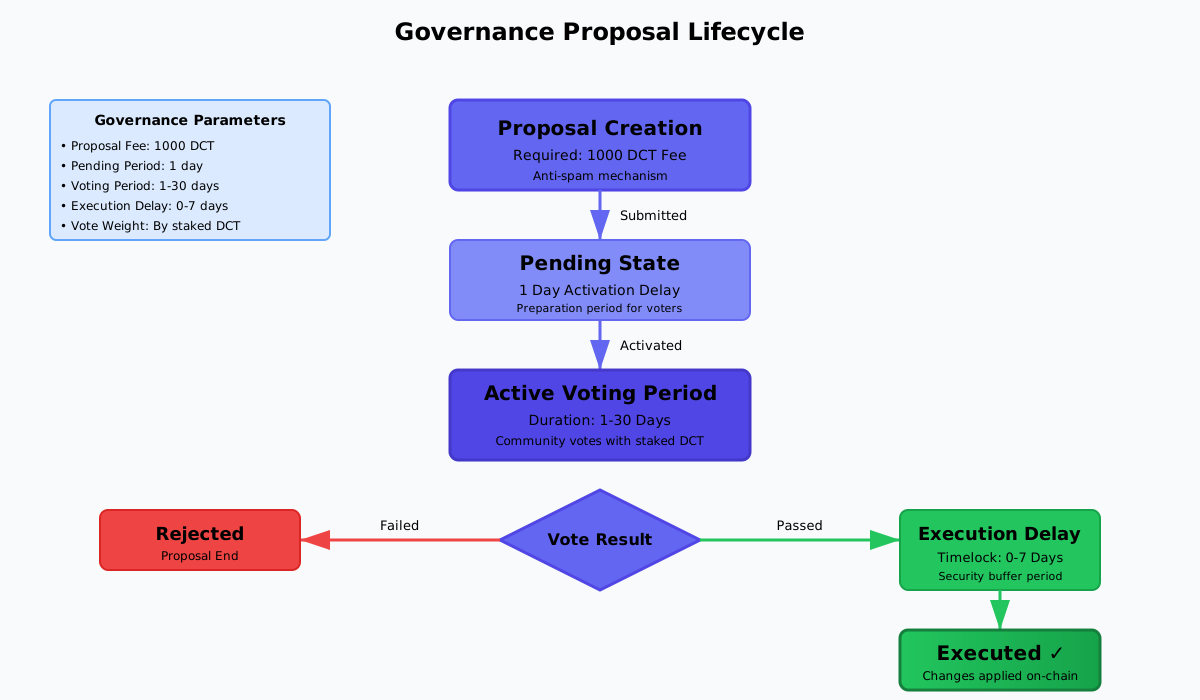
The governance system enables DCT token holders to control protocol parameters, treasury allocations, and system upgrades. Proposal types include Parameter Proposals (change system parameters), Treasury Proposals (allocate treasury funds), Upgrade Proposals (upgrade smart contracts), and Governance Proposals (change governance rules).
Voting mechanism: Voting power is proportional to staked DCT amount, with minimum 30-day staking period, 1000 DCT proposal fee, voting duration 1-30 days (configurable), quorum threshold minimum 100 DCTX voting power, and execution delay 0-7 days (enforced by timelock).
4.5 Staking Mechanisms
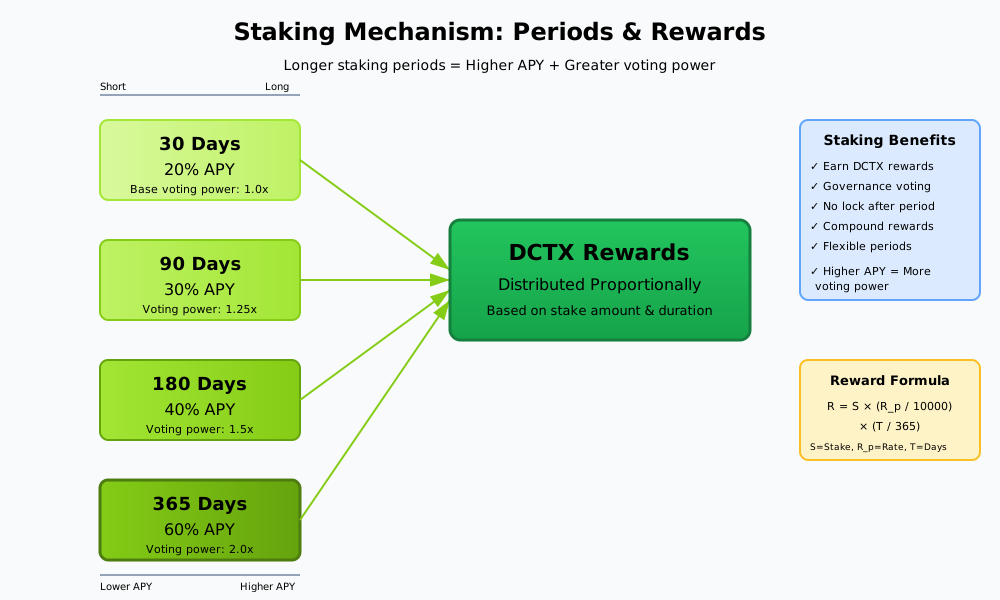
DCT Staking (Governance): Purpose is to earn rewards and gain voting power. Staking periods: 30 days (20% APY), 90 days (30% APY), 180 days (40% APY), 365 days (60% APY). Features include minimum 30-day staking required for voting power, rewards distributed in DCTX, cannot change staking period after initial stake, must complete full period before unstaking.
DCTX Staking (Utility): Purpose is to earn passive rewards on utility tokens. Same staking periods as DCT staking with similar APY structure. Features include no governance voting power, rewards in DCTX, flexible unstaking after period completion.
4.6 Vesting and Timelock Systems
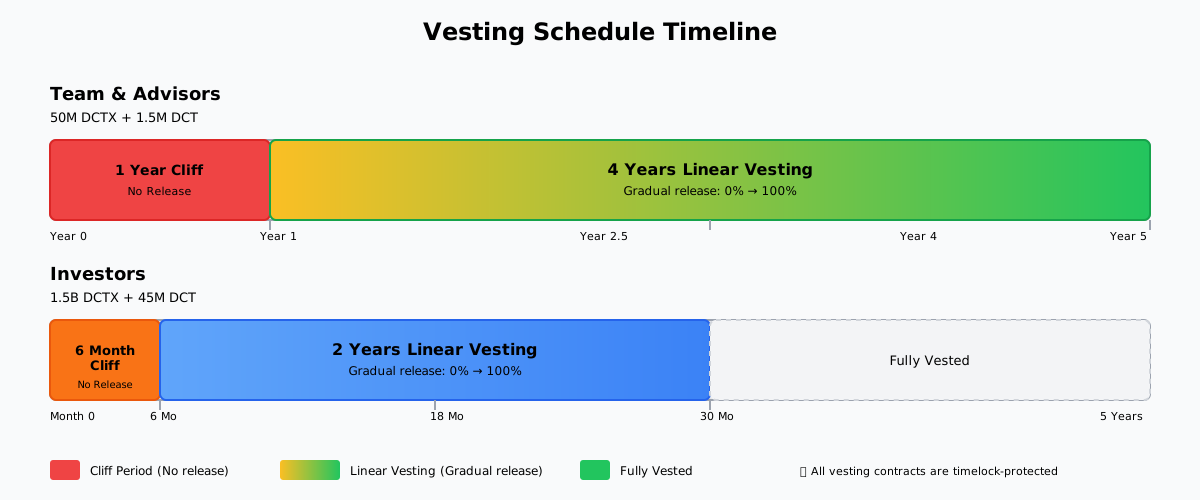
Team & Advisors: DCTX 1.5B at launch, 1-year cliff, 4-year linear vesting. DCT 61,875,000 at launch, 1-year cliff, 4-year linear vesting. Breakdown: Founder (28,875,000 DCT), Co-founder (23,000,000 DCT), New Team/Advisors (10,000,000 DCT).
Investors: DCTX 1B total, 6-month cliff, 2-year linear vesting. DCT 40,250,000 total, 6-month cliff, 2-year linear vesting.
Timelock Protection: CustomTimelock implements per-function-type delays. Delay types: Emergency (0 hours, immediate, owner-only), Parameter Changes (24 hours), Pause/Unpause (48 hours), Contributor Onboarding (72 hours), Governance Execution (7 days). Protected Contracts: 15 of 21 contracts have ownership transferred to timelock.
5. Mathematical Formalization
5.1 Token Injection Formula
The core formula for calculating DCTX injection amounts:
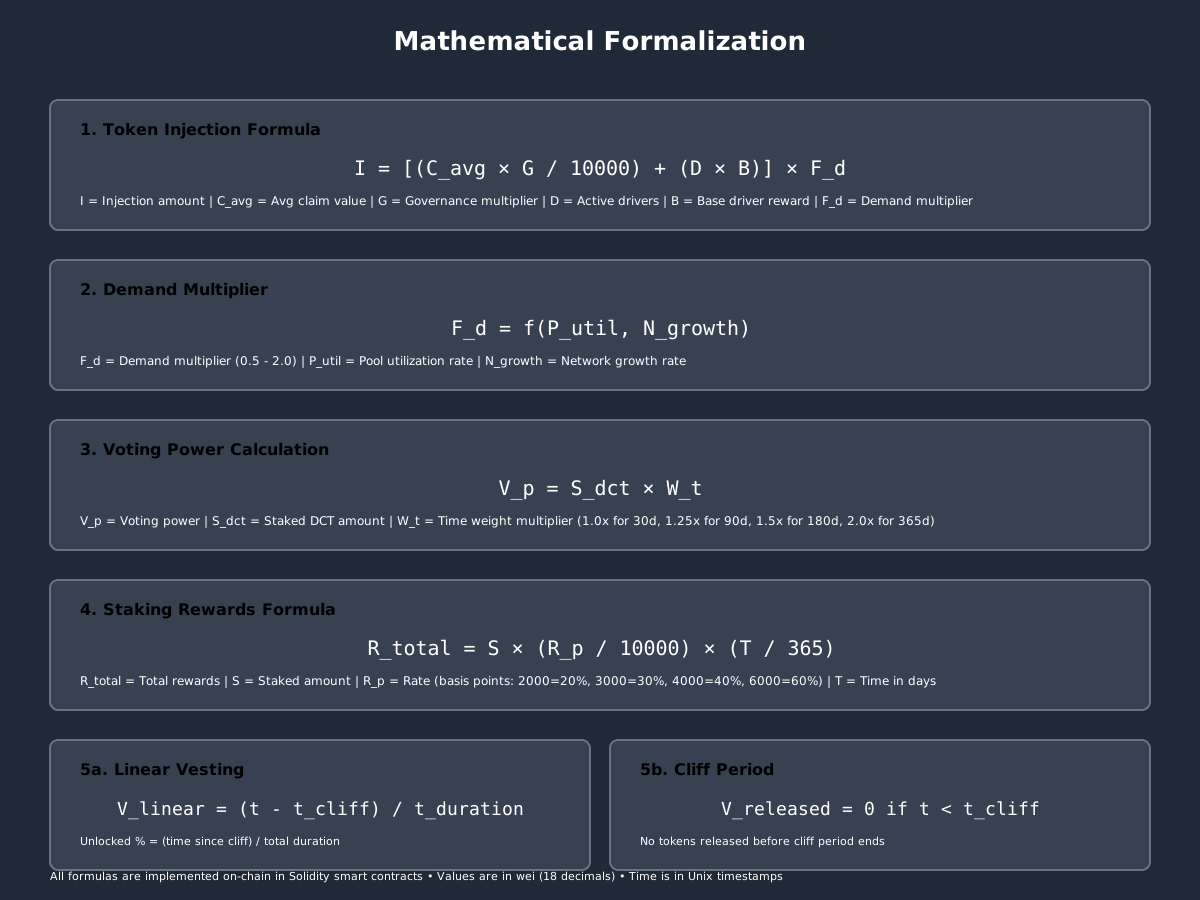
Example Calculation: Average claims 50,000 DCTX, Active drivers 1,000, Growth rate 200 basis points (2%), Base mint 10 DCTX, Demand factor 1.2x. Result: I = [(50,000 × 200 / 10000) + (1,000 × 10)] × 1.2 = 13,200 DCTX
5.2 Demand Multiplier Calculation
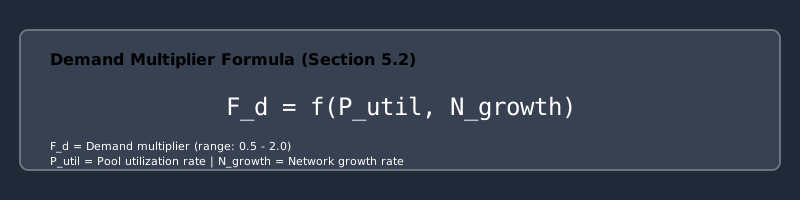
The demand factor adjusts injection amounts based on pool utilization: F_d = f(P_util, N_growth) where P_util is pool utilization percentage and N_growth is network growth metrics.
Calculation Logic: Calculate pool utilization P_util = (current_pool_balance / target_pool_size) × 100. Assess network growth by comparing current metrics to historical averages. Apply adjustment: Low utilization (< 50%): Increase factor (up to 2.0x), High utilization (> 90%): Decrease factor (down to 0.5x), Normal utilization (50-90%): Factor near 1.0x. Bounds: 0.5 ≤ F_d ≤ 2.0
5.3 Governance Voting Power
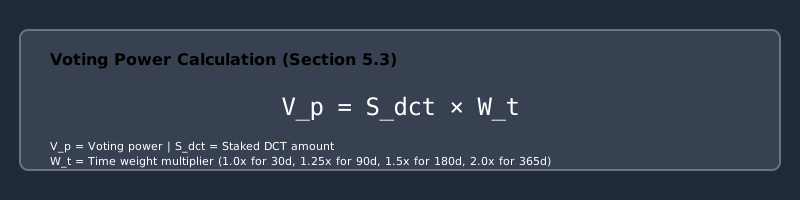
Voting power is proportional to staked DCT amount: V_p = S_dct × W_t where V_p is voting power, S_dct is staked DCT amount, and W_t is time weight (1.0 for 30+ days staked).
Quorum Requirement: Σ(V_p) ≥ Q where Q is the quorum threshold (minimum 100 DCTX equivalent, configurable per proposal).
5.4 Staking Rewards Calculation
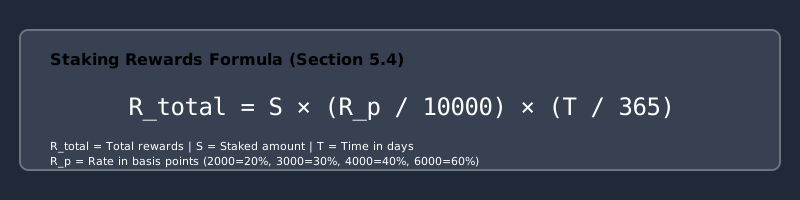
Staking rewards are calculated based on period and amount: R_total = S × (R_p / 10000) × (T / 365) where R_total is total rewards earned, S is staked amount, R_p is reward rate in basis points, and T is staking period in days.
Reward Rates: 30 days: 2000 basis points (20% APY), 90 days: 3000 basis points (30% APY), 180 days: 4000 basis points (40% APY), 365 days: 6000 basis points (60% APY).
6. Security and Safety
6.1 Timelock Protection
CustomTimelock Implementation: 15 of 21 contracts have ownership transferred to timelock. Per-function-type delays prevent immediate execution. Community review period before critical changes.
Delay Types and Durations: Emergency (0 hours, immediate, owner-only), Parameter Changes (24 hours), Pause/Unpause (48 hours), Contributor Onboarding (72 hours), Governance Execution (7 days).
Protected Operations: Parameter updates in RewardsMonetarySystem, Governance proposal execution, Treasury allocations, Contract upgrades, Vesting schedule modifications.
6.2 Multi-Signature Wallets
Gnosis Safe Implementation: 7 Safes deployed on Polygon Mainnet. Critical wallets require 3 of 5 signers. Operational wallets require 2 of 3 signers.
Critical Wallets (3 of 5, 48h timelock): Team & Advisors, Reserve/Treasury, Community Self.
Operational Wallets (2 of 3, 24h timelock): Marketing/Airdrops, Liquidity, App Development, Investors.
6.3 Security Measures
Security Measures Implemented: ReentrancyGuard on all external functions, SafeMath for arithmetic operations (Solidity 0.8.20 overflow protection), Access control (Ownable pattern), Input validation on all user inputs, Timelock protection on critical functions.
Recommended Audits: Smart contract security audit (recommended before mainnet), Economic model review, Governance mechanism analysis, Front-running and MEV protection review.
7. Tokenomics and Economics
7.1 Token Allocation Strategy
DCT Token Allocation (575M Total Supply): Team & Advisors 20% (115,000,000 DCT total, with 61,875,000 DCT allocated at launch and 53,125,000 DCT remaining, 1-year cliff, 4-year linear), Strategic Sale 7% (40,250,000 DCT, 6-month cliff, 2-year linear), Marketing & Airdrops 12% (69,000,000 DCT, milestone-based), Liquidity 20% (115,000,000 DCT, gradual release), Protocol Grants 10% (57,500,000 DCT, governance-controlled), Governance Staking 16% (92,000,000 DCT, participation-based), Contributor Incentives 10% (57,500,000 DCT, milestone-based), Reserve/Treasury 5% (28,750,000 DCT, emergency only).
| Category | Allocation | Quantity | Release Schedule |
|---|---|---|---|
| Team & Advisors | 20% | 115,000,000 (61,875,000 allocated, 53,125,000 remaining) | 1-year cliff, 4-year linear |
| Strategic Sale | 7% | 40,250,000 | 6-month cliff, 2-year linear |
| Marketing & Airdrops | 12% | 69,000,000 | Milestone-based |
| Liquidity | 20% | 115,000,000 | Gradual release |
| Protocol Grants | 10% | 57,500,000 | Governance-controlled |
| Governance Staking | 16% | 92,000,000 | Participation-based |
| Contributor Incentives | 10% | 57,500,000 | Milestone-based |
| Reserve/Treasury | 5% | 28,750,000 | Emergency only |
7.2 DCTX Token Allocation and Distribution Schedule
DCTX Token Allocation (20B Total Supply): Investors 5% (1,000,000,000 DCTX, 6-month cliff, 2-year linear), Team & Advisors 20% (4,000,000,000 DCTX total, 1,500,000,000 at launch and 2,500,000,000 remaining, 1-year cliff, 4-year linear), Marketing & Airdrops 10% (2,000,000,000 DCTX, milestone-based), Liquidity 20% (4,000,000,000 DCTX, gradual release 6–12 months), App Development 15% (3,000,000,000 DCTX, milestone-based), DCTX Rewards 20% (4,000,000,000 DCTX, dynamic minting activity-based), Reserve 5% (1,000,000,000 DCTX, emergency only), Community Self 5% (1,000,000,000 DCTX, governance-controlled).
| Category | Allocation | Quantity | Release Schedule |
|---|---|---|---|
| Investors | 5% | 1,000,000,000 | 6-month cliff, 2-year linear |
| Team & Advisors | 20% | 4,000,000,000 (1,500,000,000 at launch; 2,500,000,000 remaining) | 1-year cliff, 4-year linear |
| Marketing & Airdrops | 10% | 2,000,000,000 | Milestone-based |
| Liquidity | 20% | 4,000,000,000 | Gradual release (6–12 months) |
| App Development | 15% | 3,000,000,000 | Milestone-based |
| DCTX Rewards | 20% | 4,000,000,000 | Dynamic minting (activity-based) |
| Reserve | 5% | 1,000,000,000 | Emergency only |
| Community Self | 5% | 1,000,000,000 | Governance-controlled |
7.3 Economic Stability Mechanisms
Supply Caps: Daily mint cap 1,000,000 DCTX, Annual mint cap 100,000,000 DCTX, Maximum annual growth 0.5% of total supply.
Deflationary Mechanisms: Multi-source burn model—explicit on-chain burns, DCTXLiquidityPool settlement burns (configurable basis points), RewardVault penalty flows (including dead-address transfers that do not reduce total supply), user-initiated burning, and governance-controlled buyback and burn. There is no global burn percentage on ordinary transfers, router trades, or swaps.
Demand-Responsive Design: Injection amounts scale with activity, Demand factor prevents pool depletion, Counter-cyclical adjustments during economic stress.
8. Future Roadmap
8.1 Freight Digitization
Vision: Transform physical freight into digital assets for DeFi integration. Features: Bill of Lading (BOL) scanning and tokenization, Real-time GPS tracking on blockchain, Collateral-based lending against freight value, Automated settlement on delivery confirmation.
Revenue Model: Digitization fees 2.5% of commodity value, Financing revenue 12% APR on loans, Trading fees 0.5% on freight token trades. Market Potential: $800B global freight industry, $200B+ addressable market.
8.2 Cross-Chain Expansion
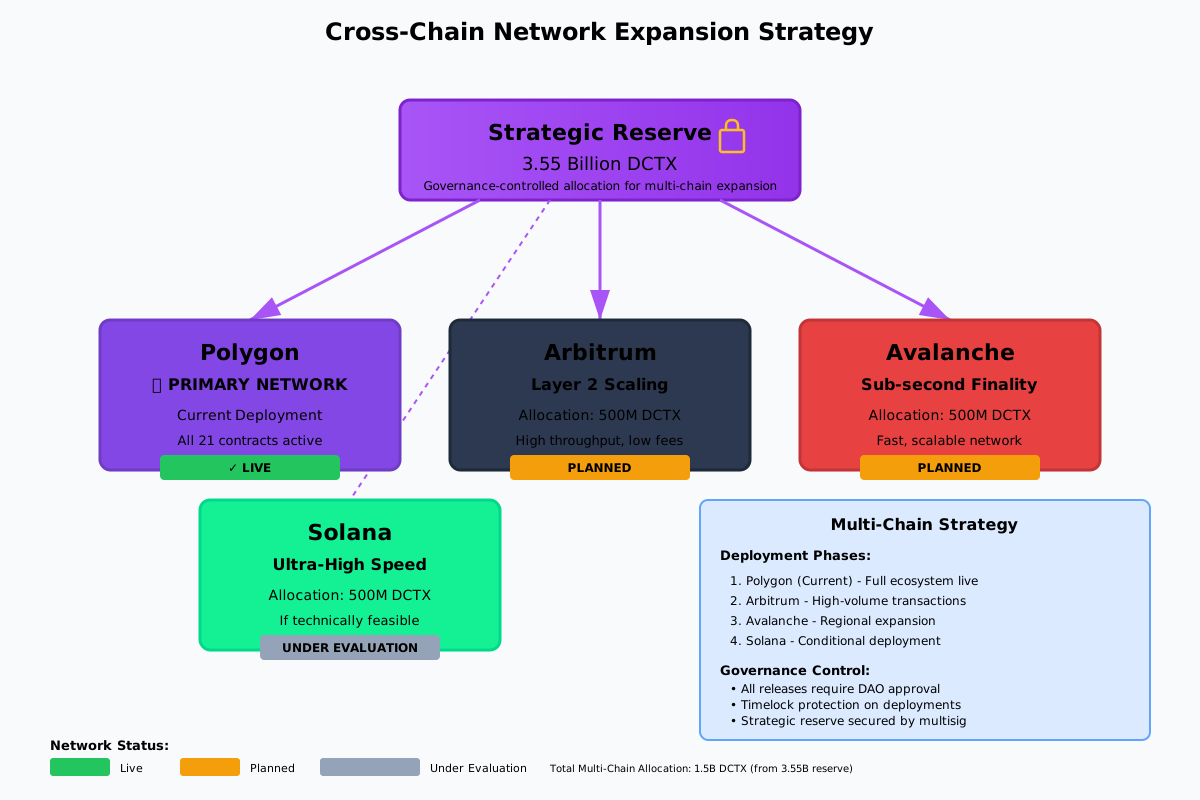
Strategic Reserve: 3.55B DCTX (88.75% of liquidity allocation). Planned Deployments: Arbitrum 500M DCTX, Solana 500M DCTX (if technically feasible), Avalanche 500M DCTX. Governance Control: All cross-chain releases require community approval. Milestone Triggers: CEX listings, BTC pairing availability, Staking incentive programs.
8.3 TMS Platform Vision
Complete Transportation Management System: Full freight lifecycle management, Automated digitization workflows, Multi-sector support (manufacturing, warehousing, transportation, shipping), Integration with existing logistics systems.
Platform Features: Mobile app with wallet connectivity, Real-time movement tracking, Automated reward distribution, Compliance and reporting tools.
10. Acknowledgments
The DriveChains protocol represents the collaborative effort of developers, advisors, and community members committed to creating a fair and sustainable blockchain ecosystem for the logistics industry.
Special Recognition: Development team for comprehensive smart contract implementation, Security reviewers for identifying and addressing vulnerabilities, Community members for governance participation and feedback.
Technical Acknowledgments: OpenZeppelin for security patterns and best practices, Polygon network for scalable infrastructure.
11. References
Document Version: 1.0
Last Updated: November 17, 2025
Status: Pre-Mainnet (Polygon Amoy Testing Complete)